Prompt Guardrails Need Artifact Contracts
Jun 15, 2026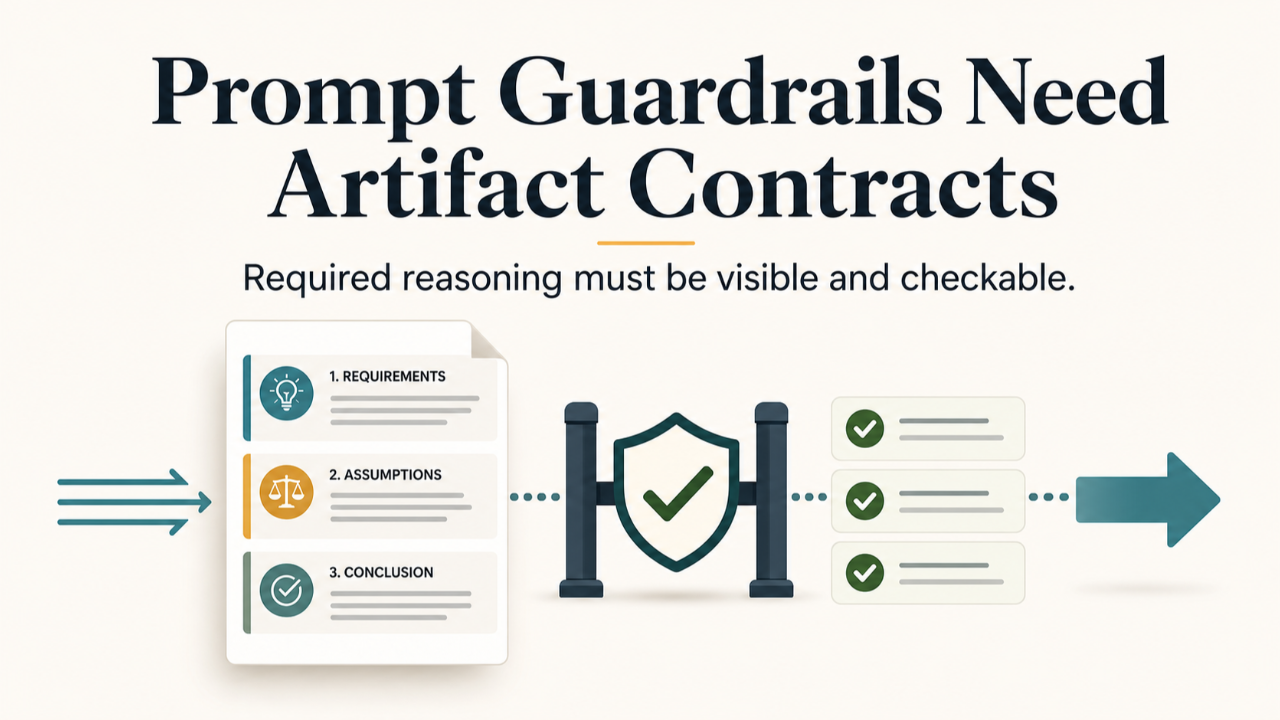
Important review obligations should not live only as prompt instructions. When a review artifact controls whether work moves forward, the required reasoning needs to be visible in the artifact and checked before advancement.
Opening
The easiest governance mistake in an AI-assisted workflow is to confuse an instruction with a guarantee.
You can tell a reviewer, human or AI, to check whether a plan still preserves the original product intent. You can make that instruction bold. You can repeat it in a few places. But if the artifact can still say "accepted" without showing that the check happened, the workflow is trusting shape instead of substance.
Problem
The surface problem is usually phrased as prompt quality: "The review prompt should say this more clearly."
That is sometimes true, but it is not enough when the review controls downstream action. If a review artifact advances a workflow, the system needs to know whether the required reasoning is present. A valid verdict label is not the same thing as a complete review.
The failure mode is quiet:
- the artifact has the expected verdict shape
- the workflow parser accepts the verdict
- the next stage begins
- the reasoning that should have protected the original intent is missing
No one deliberately skipped the guardrail. The guardrail simply had no enforceable form.
Story / example
A workflow needed its spec and plan reviews to preserve the original product intent. The risk was not that reviews were absent. The risk was that reviews could pass by producing the right verdict label while omitting the section that proved product intent had been checked.
The durable fix was deliberately small. The review artifacts were required to include explicit product-intent sections. Accepted reviews were validated for those sections before the workflow advanced. Missing sections produced a refusal instead of a quiet pass.
That is a different kind of fix from "tell the reviewer harder." The prompt still matters, but the artifact now has a contract that downstream automation can inspect.
Lesson
Prompt-only guardrails are weak when the outcome matters.
If an artifact controls stage advancement, the important obligations inside that artifact need three things:
- a visible place in the artifact
- a defined failure path when that place is missing
- focused tests for the missing-section case
This does not require a giant schema. In many cases, a narrow section-presence check is enough. The point is not to parse every nuance of the review. The point is to block the old failure mode: a successful-looking artifact that is missing the reasoning the workflow depends on.
Broader implication
This pattern applies beyond spec and plan reviews.
It applies to approval memos, AI-generated plans, handoff notes, incident reviews, audit reports, launch checklists, and any other artifact that decides what happens next. If the artifact is only informational, prompt guidance may be enough. If the artifact changes workflow state, required reasoning should become part of the artifact contract.
The practical question is:
If this reasoning step is missing, should the workflow still advance?
If the answer is no, the reasoning step should not live only in the prompt.
Closing
Good prompts request the behavior. Good artifact contracts make the workflow refuse when the behavior is absent.
