Versioned Contracts Bind Post-Audit Normalization and Failure Evidence
Jul 29, 2026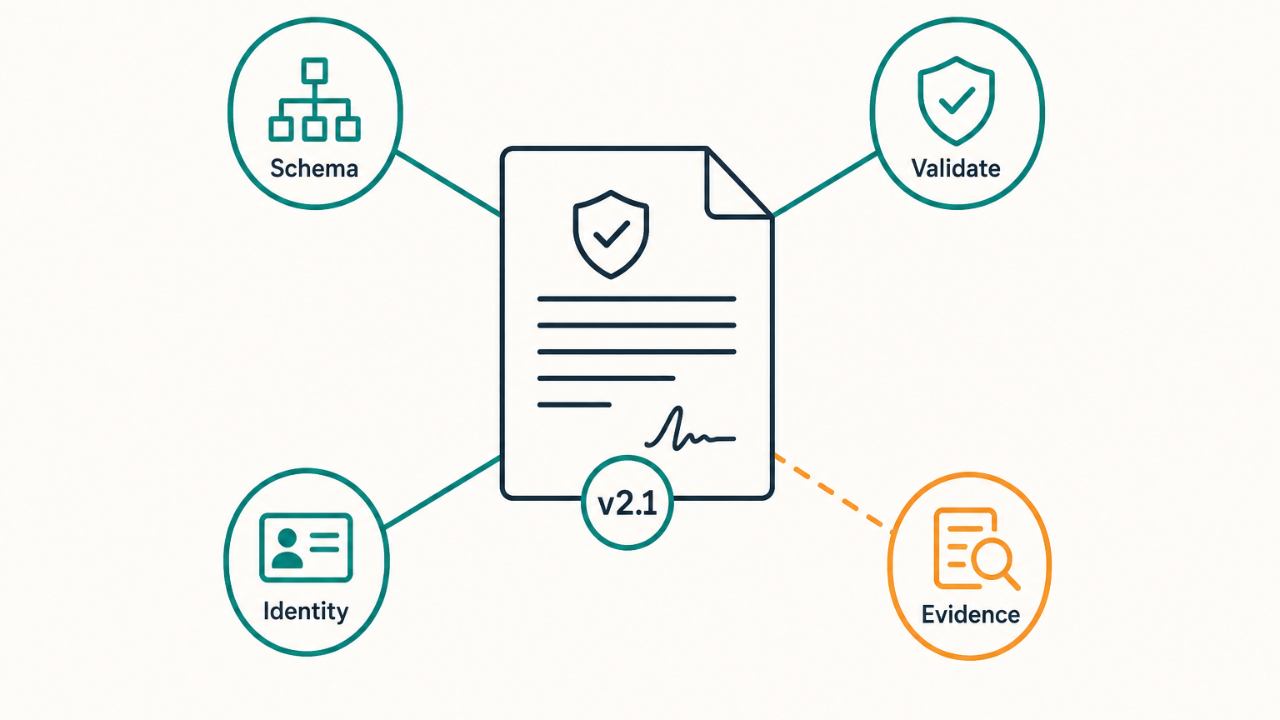
Post-audit normalization that asks a producer to emit structured output without supplying the actual schema, valid examples, or trusted identities will fail unpredictably. Treat schema, validation, identity binding, and failure evidence as one versioned contract surface.
The problem
A common pattern in governed automation: an audit completes, the system normalizes the result into structured state, then routes based on that state. The normalization step looks simple — translate a verdict into a canonical disposition — but it sits at a critical boundary.
When that normalizer fails, the visible symptom is a malformed output. The natural instinct is to fix the parser, improve the prompt wording, or add a retry. These rarely solve the problem because the real defect is upstream: the producer was never given the contract it was asked to satisfy.
What actually happened
A normalizer was required to emit structured output with specific fields, valid dispositions, and controller-owned identifiers. But the live invocation supplied only a generic instruction. No schema. No valid example. No stage-specific context. No trusted identity values.
The model was being asked to satisfy a contract it had never seen.
Worse, the same normalizer served multiple stages. A fix scoped to one stage would leave the others broken. The defect was a contract gap across the entire normalization boundary.
The lesson
Schema delivery, validation, identity authority, and failure diagnostics are not four separate concerns. They are one operational contract:
- Schema and examples tell the producer what to emit.
- Validation tells the consumer what to accept.
- Identity binding separates trusted controller-derived facts (identifiers, references, run context) from model-authored content (summaries, claims).
- Failure diagnostics preserve what went wrong — bounded previews, hashes, phase classification, expected values — so you can diagnose without re-running.
If you fix only one of these, the system remains unreliable or undiagnosable. A model that passes validation but controls lifecycle identifiers is dangerous. A model that fails validation with no diagnostics is opaque. A model that receives no schema but is expected to produce one specific shape is unreliable by construction.
The broader principle
Shared lifecycle seams need executable, versioned contracts — not prose references to unnamed schemas.
Wherever a producer emits structured output that a downstream consumer validates and routes on, the contract should be:
- Single-owned — one authoritative definition, not scattered inline expectations.
- Machine-readable — the prompt, validator, and example surfaces all derive from the same source.
- Versioned — changes to the contract are explicit, not ambient.
- Identity-aware — distinguish trusted facts (derived by the controller) from advisory content (produced by the model).
- Evidence-preserving — invalid output is durably diagnosed, not silently discarded.
This applies beyond AI systems. Any automation boundary where structured output crosses a trust boundary benefits from the same discipline.
How to apply it
When you encounter a normalization or structured-output failure:
- Check contract delivery first. Does the producer actually receive the schema, a valid example, and the stage-specific context it needs? If not, fix delivery before touching the parser.
- Scope the fix to the full seam. If multiple callers share the same normalization path, all of them need parity — not just the one where the failure surfaced.
- Separate trusted from advisory fields. Controller-owned identifiers should be derived and exact-match validated, not left to the model to guess.
- Preserve failure evidence. When output is invalid, capture bounded diagnostics — what was expected, what was received, at what phase — before rejecting.
- Test with discriminators. Include at least one regression test that restores the old (broken) prompt or contract and proves the system fails. Positive conformance alone is insufficient.
A note on governance overhead
In governed systems, fixing the production code is often the smaller problem. The harder part is ensuring that acceptance criteria, verification language, and test-fixture rules are mutually consistent. Ambiguities in specification can force expensive rework loops even when the implementation is sound.
Two practices help:
- Test criteria for internal satisfiability before implementation begins. Can every acceptance criterion be met simultaneously? Do production-only rules accidentally prohibit legitimate test fixtures?
- Classify audit findings explicitly. Distinguish implementation defects from missing evidence, criteria defects, and stale verification wording. Route each to the authority layer that actually contains the defect rather than forcing a full-path rework for an evidence-only gap.
