Safe CLI Wrappers Preserve Authority Boundaries
Jun 11, 2026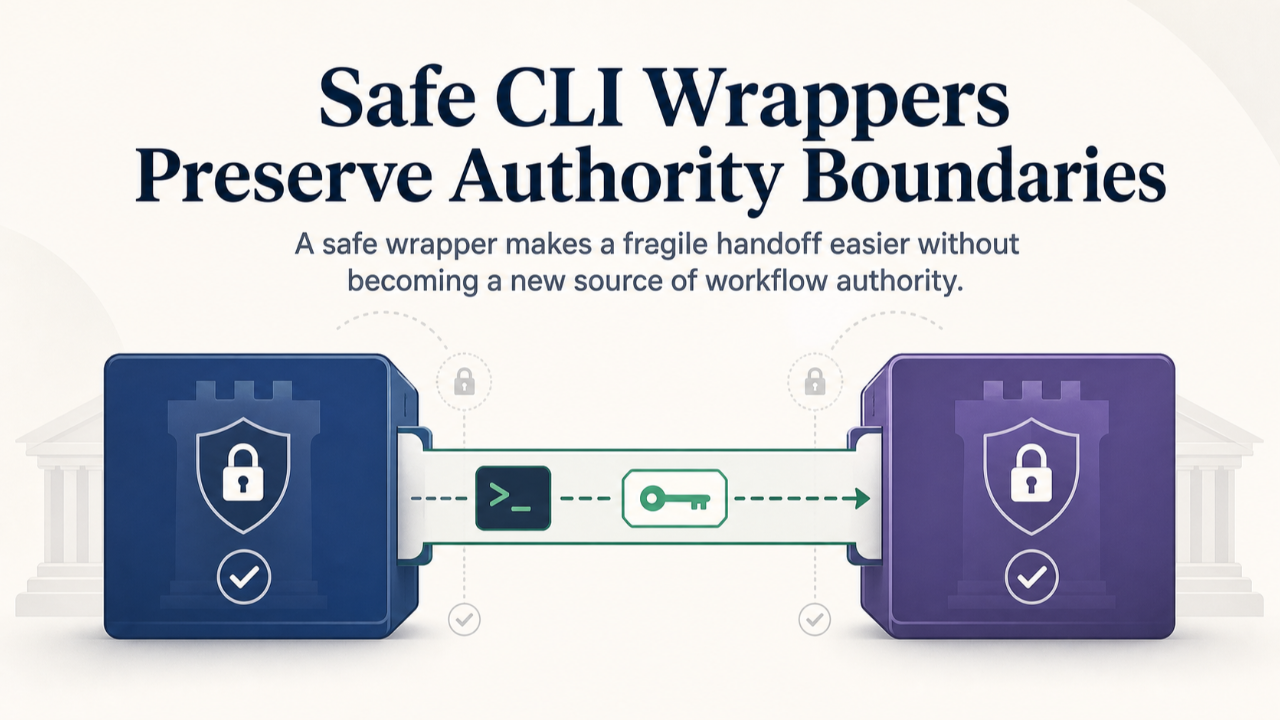
A wrapper command should make the right workflow path easier to run without becoming a second source of lifecycle truth. The safer pattern is to compose existing authority surfaces, capture explicit handoff signals, validate them, and stop at the next legitimate boundary.
Opening
Convenience code is not automatically harmless.
A small wrapper can remove a tedious operator step. It can also quietly become a second control system if it starts copying the logic owned by the commands underneath it.
The difference matters most in governed workflows, where "just make it easier to run" can cross process, state, and approval boundaries.
Problem
The surface problem was simple: an operator needed a safer way to move from setup into the next workflow stage.
The real problem was the handoff. A setup command created the target work. A controller command continued execution. Between them sat a manual step where the operator had to preserve the right target path and pass it forward correctly.
That handoff was easy to break. One empty variable, stale path, or copied command could send the run into the wrong state.
The fix was not to redesign the lifecycle. The fix was to make the handoff safer.
Story / Example
The important design choice was restraint.
The setup command already owned creation. The controller already owned continuation. The new wrapper did not need to become either of those things.
Instead, the wrapper had a narrower job:
- accept the raw input
- call the existing setup command through its normal command boundary
- capture explicit structured output
- parse the created target
- validate that the expected scaffold exists
- call the existing controller path
- stop at the intended review boundary
- print the next commands for the operator
That shape avoided a common trap. The wrapper improved the operator experience without duplicating the workflow's source of authority.
Lesson
A safe wrapper composes authority surfaces. It does not replace them.
When a command is built as a CLI, especially one with exit-heavy behavior, treating it as a subprocess can be the lower-risk choice. The wrapper can preserve the tool's existing contract, read its output, and fail closed if the handoff signal is missing or ambiguous.
The same principle applies beyond CLIs. A wrapper around a workflow, review step, deployment tool, or AI worker should be explicit about what it owns and what it only calls.
It may own:
- input validation
- command composition
- handoff parsing
- local safety checks
- operator-facing next steps
It should not quietly own:
- lifecycle state
- approval authority
- routing rules
- governance decisions
- success criteria that belong to the wrapped system
Broader Implication
The question to ask is not "Can this be one command?"
The better question is: "What authority would this command accidentally acquire?"
If the answer includes lifecycle progression, approval bypass, hidden state mutation, or duplicated routing logic, the wrapper is doing too much.
A useful wrapper should make the right path easy and the wrong path harder. It should define the input contract, call the existing authority surface, validate the handoff, and stop at the next legitimate boundary.
Closing
The best automation wrappers are intentionally boring. They reduce fragile handoffs, preserve control boundaries, and leave lifecycle truth where the system already put it.
