Retry Is Not Rework
Jun 06, 2026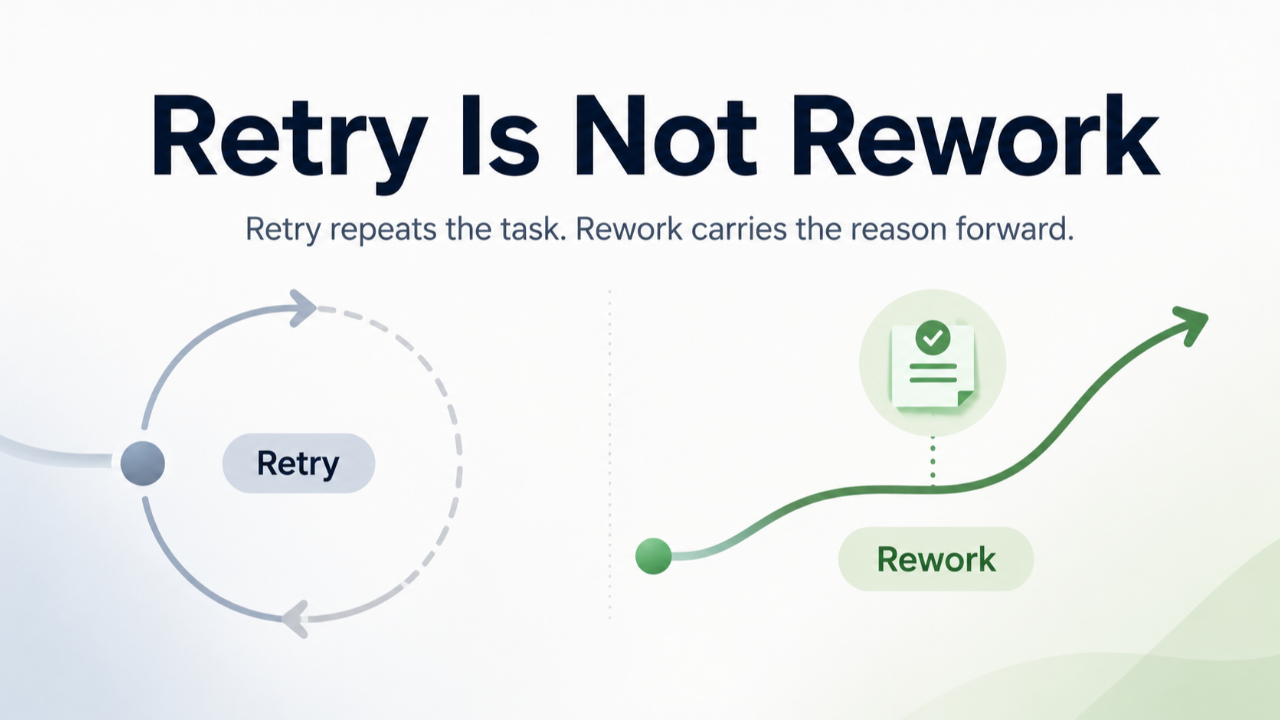
Retry repeats a task. Audit-driven rework carries forward the reason the previous attempt failed.
A workflow can look automated while still failing to improve if it only sends work back to be repeated. The difference between retry and rework is whether the next attempt receives the feedback, review findings, and work history needed to improve.
Definition
Retry means attempting the same task again.
Rework means attempting the task again with the reason for failure carried forward.
That distinction is easy to miss. A system can have a loop that sends failed work back for another attempt, but if the next person, team, or AI worker does not receive the review findings, the loop is only mechanical. It may repeat the work without improving it.
Audit-driven rework is different. It sends failed work back with the specific findings that caused the failure, preserves the previous attempt, and checks that the new version actually addresses the problem.
A simple way to say it:
Retry says, "Try again." Rework says, "Try again, using this feedback."
Why it matters
Many workflows fail quietly at the rework stage.
The work is reviewed. The work is rejected. The work is sent back. A new version appears.
On paper, the process looks complete.
But the important question is:
Did the next attempt receive the reason the last attempt failed?
If not, the loop is weak. The worker may repeat the same misunderstanding. The reviewer may see the same problem again. The system may create activity without progress.
This matters in many settings:
- document review
- software review
- design review
- compliance review
- approval workflows
- customer support escalation
- automated or AI-assisted workflows
- quality assurance
- operational handoffs
The more automated the workflow becomes, the more important this distinction becomes. Automation can make repetition faster, but faster repetition is not the same as better correction.
Common failure mode
The common failure mode is a mechanical retry loop.
It looks like this:
Work attempt
|
Review fails
|
Try again
|
New attempt
|
Same weakness may repeat
The loop exists, but the reason for failure is not carried forward.
This creates several problems:
- The next attempt may not address the actual issue.
- The review findings may be lost or ignored.
- The old version may be overwritten without a clear history.
- The reviewer may need to repeat the same feedback.
- The system may appear functional while failing to improve.
The dangerous part is that this can look like a working process. There is movement. There are new versions. There is activity.
But the loop is not learning from its own failure.
Better pattern
A better pattern is audit-driven rework.
It looks like this:
Work attempt 1
|
Review fails with findings
|
Save the failed attempt
|
Pass findings to the worker
|
Work attempt 2
|
Check the new working version
|
Review again
The important parts are:
-
The failed attempt is preserved. The system keeps enough history to understand what changed.
-
The review findings are carried forward. The next attempt receives the reason the previous attempt failed.
-
The new working version is checked. The system confirms that the revised work is in the right place and is the version being reviewed.
-
The real workflow path is tested. It is not enough to prove that one helper step works. The actual review-and-rework path needs to work.
-
The loop can stop when evidence is missing. If the system cannot identify the rejection reason, preserve the failed attempt, or check the new version, it should pause rather than pretend the rework is valid.
Example
Imagine a team has a document approval process.
A draft policy is reviewed and rejected because it does not explain who owns a key decision. The document is sent back to the author.
In a weak retry loop, the author simply receives:
"Please revise."
The author may improve the wording, add another paragraph, or restructure the document, but still miss the actual issue: decision ownership.
In an audit-driven rework loop, the author receives:
"Please revise. The previous version failed because it does not explain who owns the decision after review."
The failed version is preserved. The review finding is attached to the next attempt. The revised version is checked against the original rejection reason.
That is rework, not just retry.
Related concepts
- Governed Workflows
- Audit-Driven Rework
- Feedback Artifacts
- Review Loops
- Version History
- Handoffs and Context Transfer
- Fail-Closed Workflow Design
- Human Gates
- Output Review
- Process Quality
