Generated Output Is an Interface Contract
Jun 07, 2026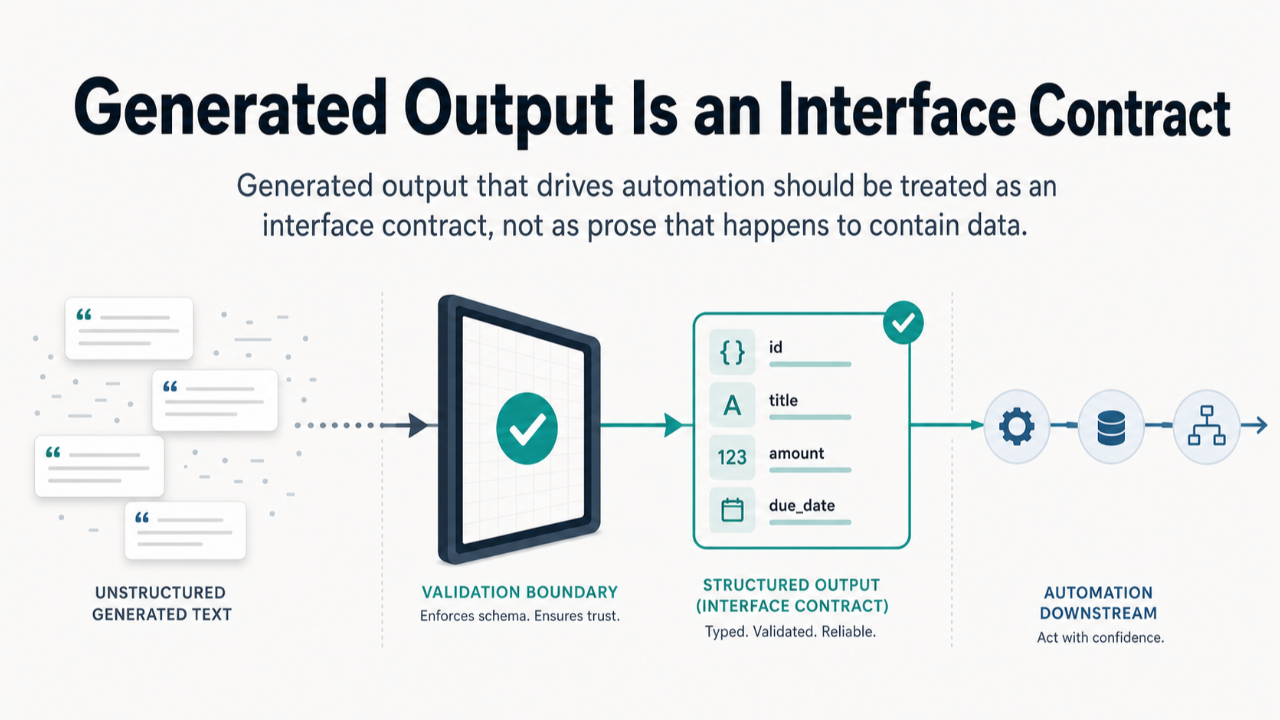
Generated output that drives automation should be treated as an interface contract, not as prose that happens to contain data. Define the expected structure, validate each response layer, and fail closed before downstream steps act on the result.
Definition
A generated output contract is the formal expectation for machine-readable output produced by a model, tool, or automated step. It defines the expected structure, validation rules, error handling, and conditions under which the workflow may continue.
Why it matters
Prompt instructions can request structure, but they do not create a reliable interface by themselves. If another automated step consumes the output, the system needs a contract it can validate before acting.
Without that boundary, failures often appear downstream as parsing errors, invalid artifacts, broken handoffs, or inconsistent automation behavior.
Common failure mode
A workflow asks for structured data in a prompt, then directly parses the raw generated response. This works until the producer adds prose, formatting, missing fields, ambiguous error states, or malformed data.
The system then treats an unreliable text response as if it were an API.
Better pattern
Use a structured output path where possible.
Validate each layer before continuing:
- Confirm the producing step is invoked in the intended structured-output mode.
- Parse and validate any response wrapper.
- Reject missing, malformed, or ambiguous error states.
- Extract the structured payload only after wrapper validation.
- Validate the payload against the expected schema.
- Fail closed before downstream steps use the artifact.
The downstream validator should remain the authority for whether the artifact satisfies the workflow contract.
Example
An automated reporting workflow asks a generation step for a JSON summary that will be used to update an internal dashboard.
Weak pattern: the prompt says "return valid JSON," and the dashboard parser reads the raw response directly.
Better pattern: the workflow defines the expected summary schema, validates the response container, rejects ambiguous errors, validates the extracted payload, and only then updates the dashboard.
The lesson is not that prompts are unimportant. The lesson is that prompts are not enough when generated output becomes an automation boundary.
Related concepts
- Output Contracts
- Interface Contracts
- Structured Output
- Schema Validation
- Fail-Closed Behavior
- Automation Reliability
- Testing and Verification
- Error Handling
