Visual Continuity Is a Transition Contract
Jun 21, 2026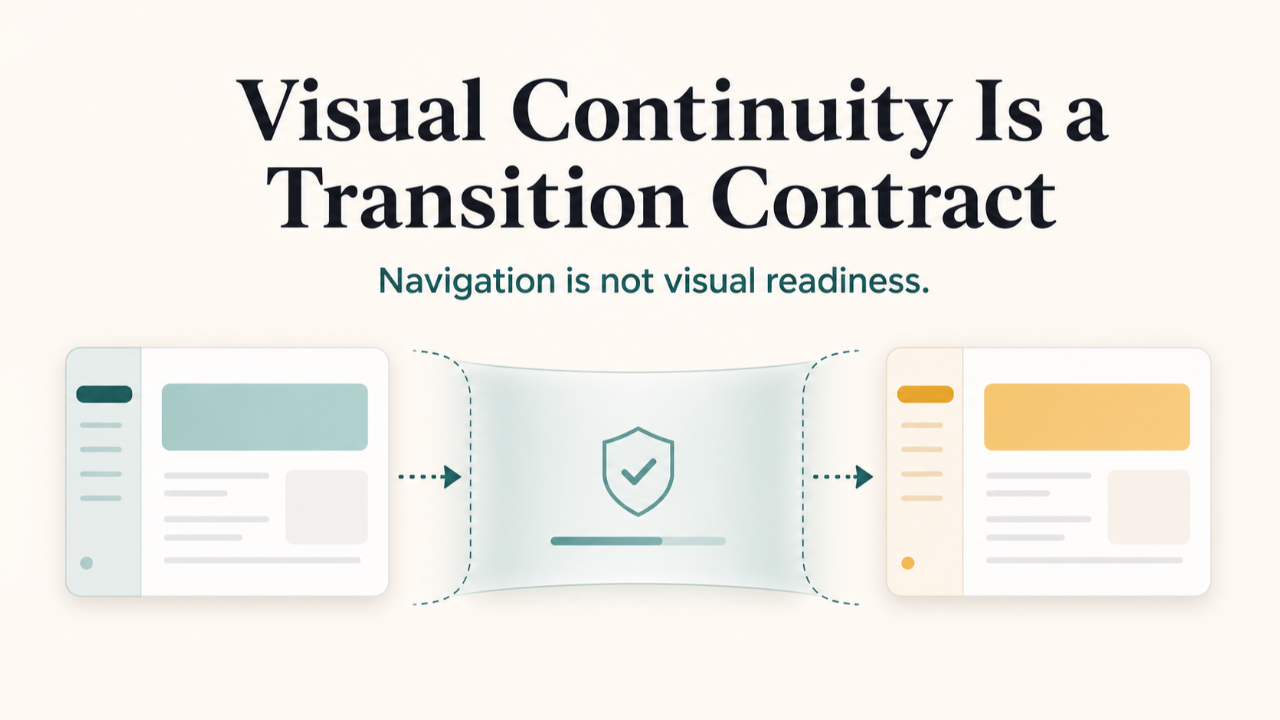
Some product bugs look smaller than they are because the final state is correct.
A user clicks, the right record is created, the URL eventually changes, and the destination screen eventually appears. On paper, the flow works.
But the user does not live on paper. The user lives in the handoff.
If the old surface disappears before the new surface is meaningfully ready, the product can briefly show stale context, the wrong page, or a blank gap. That flash may last less than a second, but it still tells the user the system lost its grip on the journey.
Problem
The tempting diagnosis is usually tactical: the modal closes too soon, the spinner is missing, or the route needs to be awaited.
Sometimes one of those statements is true. Often, none of them is enough.
The deeper question is ownership:
Who owns the visual layer before the action?
Who owns the visual layer while navigation or data loading is pending?
Who proves the next meaningful visual state is ready before the old one is allowed to disappear?
Without clear answers, each layer does something plausible in isolation. The modal closes because the create action succeeded. The router starts moving to the destination. The destination screen prepares its loading state after the route becomes active.
Between those steps, the user may briefly see the page they thought they had left.
Story / Example
In one post-create flow, the visible problem appeared to be simple: after creating something, the dashboard or library page could briefly reappear before the new destination was ready.
The obvious fix would have been to delay the modal close or wait for navigation.
But the flow had several entry points. They looked similar to the user, but they did not behave the same way internally. One already waited for navigation. Others started navigation and dismissed the modal synchronously. A route-level loading state also needed to cover broader navigation, not only the create flow.
That changed the shape of the problem.
The desired invariant was not "always show this exact skeleton frame." In very fast transitions, that frame might not visibly paint. The real invariant was simpler and more user-centered:
Do not re-expose the originating page during the transition.
That can be satisfied by a held pending layer, a route-level loading backstop, or the destination content if it is ready quickly. The implementation detail matters less than the continuity contract.
Lesson
Visual continuity is a transition contract, not a side effect of navigation.
For any transition that crosses a modal, route, skeleton, or async create operation, define:
| Moment | Question to answer | | --- | --- | | Before action | What stable surface is the user on? | | Action accepted | What confirms the action is pending? | | Navigation pending | What remains visible while the destination is not ready? | | Destination commit | What is the first meaningful destination state? | | Completion | What replaces pending state without competing with the destination? |
This is why final URL tests are weak evidence for this class of bug. A test can prove the destination eventually appears while missing the confusing flash in the middle.
The stronger proof is browser-observed transition evidence: slow the transition down, inspect each entry point, and assert that stale origin surfaces do not reappear.
Broader Implication
Transition bugs are often not about animation polish. They are about trust.
When a product moves a user from one context to another, the system is making a promise: I have your action, I know where you are going, and I will not briefly drop you back into the old state while I figure it out.
That promise needs ownership.
It also needs test coverage that matches the promise. If the promise is "no originating-page flash," test that directly. Do not settle for "the final page eventually loads."
Closing
Good transitions are owned, not hoped for.
Before dismissing the old layer, name the next one. Before calling a transition fixed, prove the handoff the user actually experiences.
