Human Review Failures Need a Return Path
Jun 23, 2026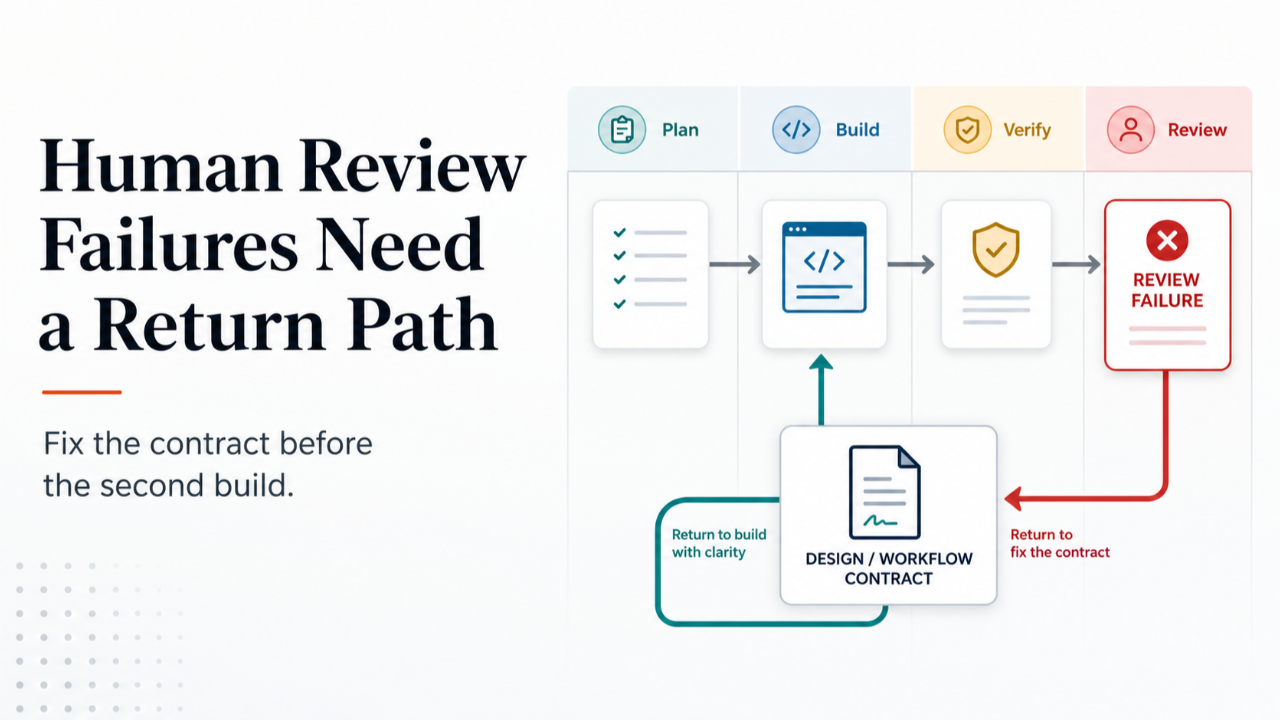
Opening
A small UI change can look finished in code and still fail in review.
The button moved. The dialog still opens. The old menu entry is gone. The tests pass far enough to show the behavior is wired.
Then someone looks at the actual screen and says: this does not feel consistent.
That is not always a subjective complaint. Sometimes it is the first clear signal that the team never wrote down the standard it expected the work to meet.
Problem
Human review often gets treated as the last checkpoint before shipping. If the reviewer finds a problem, the workflow usually sends the work back to build.
That is fine when the accepted contract was clear and the implementation missed it.
It is not fine when the review exposes a missing contract.
For visual product work, this happens often. A team may ask for one control to move into a header. The implementation may do exactly that. But when the same action appears across several similar screens, the real standard is not just "put the button there." It is:
- how large the controls should be
- how they align with neighboring actions
- how they behave under mobile pressure
- how the old entry point disappears
- what evidence proves the pattern is consistent
If those rules are not explicit before build, human review is forced to discover them late.
Story / example
In one recent workflow, a small header change crossed several related screens. The first pass moved the action into the visible header and preserved the existing behavior. From a narrow implementation view, the work was largely correct.
The problem appeared in review.
On mobile, related controls did not share the same visual rhythm. One screen had extra navigation pressure. Another had different spacing. The action worked, but the system did not yet look like a system.
The useful move was not to treat the review as a loose request to "make it look better." The team routed the finding back to planning, made the visual standard explicit, then rebuilt against that standard.
Verification changed too. The second pass did not rely only on screenshots or a general sense that the layout looked right. It used route-by-route evidence: control dimensions, ordering, absence of overflow, and checks that the new entry point worked while the old one was gone.
That made the final acceptance less subjective. The team had a contract, and the evidence matched it.
Lesson
A failed human review should trigger a routing decision before rework begins.
Ask what kind of failure it is:
| Review finding | Better route | | --- | --- | | The requirement is wrong or missing | Return to the requirements or design contract | | The requirement is clear but the build missed it | Return to build | | The build may be right but the evidence is weak | Return to verification | | The finding changes acceptance criteria | Return to the approval gate | | The issue is a preference call | Record an explicit accept, reject, or defer decision |
This distinction matters because teams can otherwise patch the visible symptom while leaving the workflow unchanged.
The next person inherits the same vague standard. The next review has to rediscover the same missing rule. The organization learns slowly, even though the reviewer already found the gap.
Broader implication
Human review is expensive. It should compound.
When review reveals a missing design rule, verification rule, safety rule, or operating standard, the workflow should capture that as a contract update. The second build should not just be a better patch. It should be built against a better standard.
This is especially important for product surfaces that look similar but are not identical. Consistency does not emerge from intent alone. It needs shared tokens, measurable parity rules, and evidence that covers each affected surface.
The same pattern applies beyond UI:
- a security review may reveal that the authorization boundary was never defined early enough
- a documentation review may reveal that the source of truth was ambiguous
- an audit review may reveal that the evidence required for acceptance was never specified
- a workflow review may reveal that a failure path has no legal continuation route
In each case, the review finding is telling you where the system is thin.
Closing
Do not send every failed review straight back to build.
First decide what failed: the implementation, the evidence, the reviewer decision, or the contract itself.
If the contract was missing, fix that before the second build.
Human review failures need a return path.
