Runtime Logs Must Respect Privacy Boundaries
Jun 20, 2026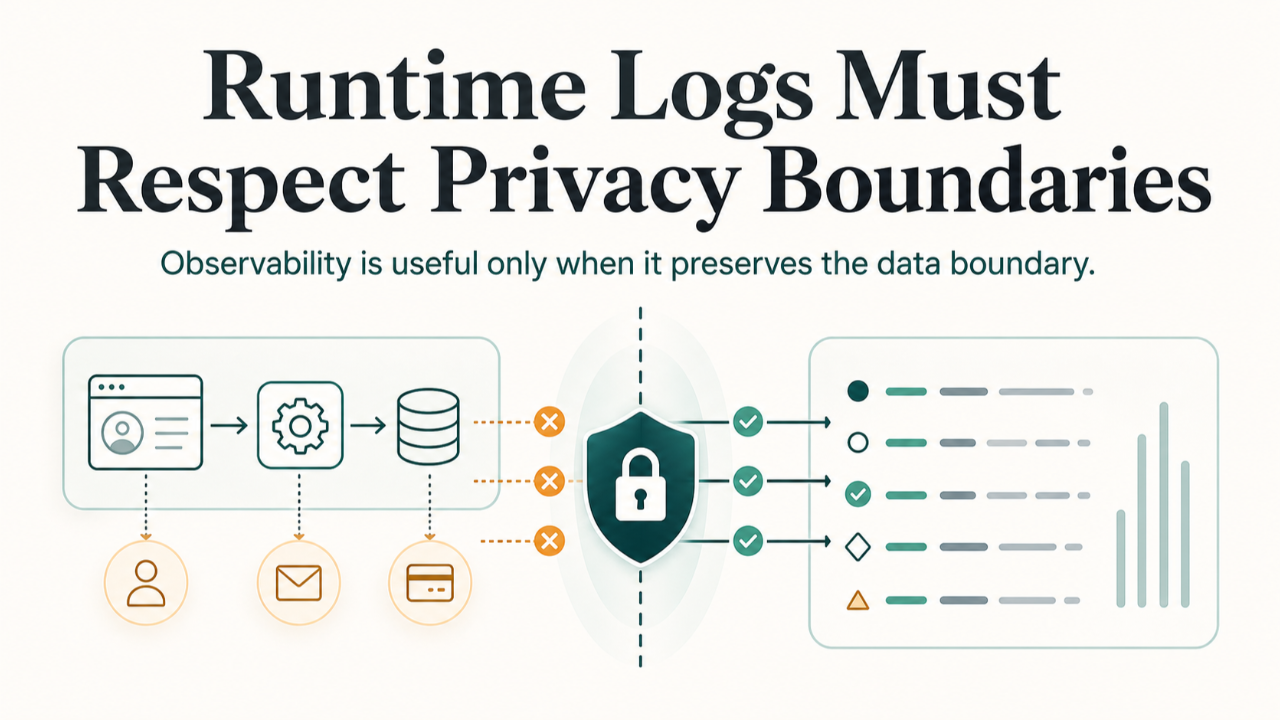
Logging cleanup sounds small until the logs sit inside authenticated product flows.
At that point, the question is not whether a message is noisy. It is whether runtime output can expose user-derived data, identifiers, records, transcriptions, generated content, invite details, metadata, or enough context to reconstruct private activity.
The Surface Problem
The visible problem was too many logs.
That framing was not wrong, but it was incomplete. Noisy logs can be a developer-experience problem. Runtime logs in authenticated flows can be a privacy boundary problem.
If a system logs raw payloads, database rows, identifiers, parsed user input, duplicate candidates, voice text, or raw error objects, the log stream becomes another data surface. It may be less visible than the UI, but it can still carry sensitive material.
The Real Problem
The real problem was uncontrolled observability.
The system needed enough operational visibility to understand ordinary execution, but not so much that routine debugging output became a secondary store of private user context.
That distinction matters because a simple "remove a few logs" pass rarely finds the full risk. Privacy-bearing logs tend to spread across server actions, API routes, client components, preview flows, local storage, background helpers, AI parsing paths, and error handling branches.
What Was Discovered
The useful discovery was that classification was harder than deletion.
Some decisions were obvious: raw user records and request-shaped objects should not be logged. Other decisions needed a rule:
- Runtime paths matter even when they are preview-only or local-first.
- Identifiers can be sensitive when they link back to people, accounts, sessions, records, or media.
- Raw error objects are unsafe by default in user-data paths.
- Expected empty states should not be logged as errors.
- Retained logs should be static operational messages, not contextual dumps.
- Static search is necessary, but it does not prove runtime behavior by itself.
The work became tractable when the rule became binary: remove unsafe runtime logging, keep only static operational messages, and preserve the logging architecture instead of replacing it with ad hoc special cases.
What Changed
The fix was a privacy hardening pass, not a cosmetic cleanup.
Unsafe runtime logs were removed or reduced to static messages. Obsolete trace logs were removed. Expected absence stopped being treated as an error worth logging. The existing logging architecture stayed intact, so the change did not become a parallel observability system.
The important discipline was preserving behavior while changing what was observable.
Why It Matters
Teams often treat logs as harmless because they are not part of the product interface.
That assumption breaks down in authenticated applications. Logs can be copied into third-party tools, retained longer than product data, searched by more people than the feature itself, and captured during preview or support workflows.
The privacy boundary is not only the screen the user sees. It includes every runtime surface where user-derived data can appear.
Evidence Is Layered
A good logging remediation needs more than "the build passed."
Different evidence answers different questions:
- Repo-wide search shows whether known logging patterns remain.
- Focused tests show whether behavior stayed intact.
- Build and integration checks show whether the application still compiles and runs.
- Browser/runtime walkthroughs show whether sensitive output still appears during real flows.
- Server log access shows whether backend paths stay quiet under realistic execution.
If runtime walkthroughs or server logs are unavailable, that should be recorded as a residual risk rather than hidden behind passing static checks.
Better Pattern
Start with an inventory, not a hunch.
For every runtime log site, decide whether it is:
- unsafe and removed
- reduced to a static operational message
- non-runtime and out of scope
- intentionally retained with a documented reason
Then verify at the right levels: static search, tests, build, browser console, and server/runtime logs where access allows.
The Reusable Lesson
Runtime logs must respect privacy boundaries.
Observability is useful only when it preserves the data contract of the system. If a log can expose user-derived data, identifiers, raw records, generated content, or private context, it belongs inside the privacy review, not outside it.
Treat logging changes as boundary changes. Keep the operational signal, remove the private context, and make any missing runtime evidence explicit.
Related Concepts
- Security and Privacy
- Testing and Verification
- Governance and Risk
- Automation Reliability
- Data Quality
