Reference Documents Don't Enforce Themselves
Jun 24, 2026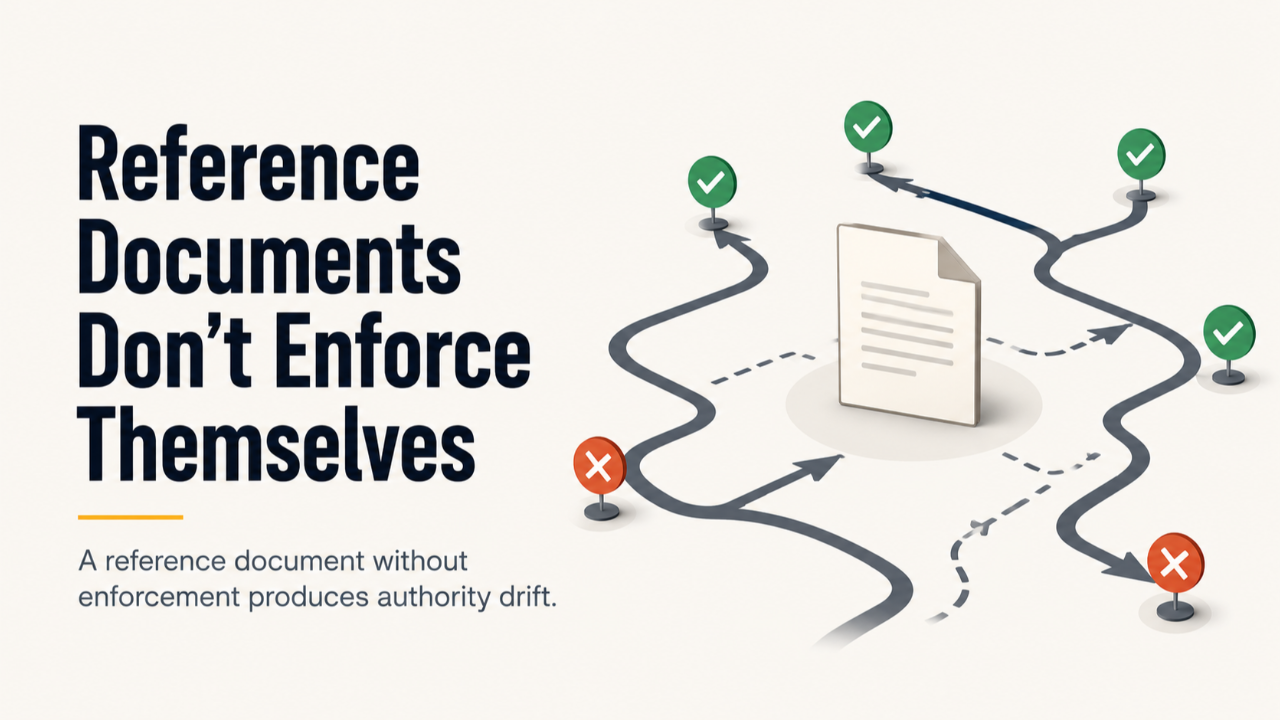
A reference document that exists but isn't operationally enforced produces a predictable outcome: documentation authority drift. Workers make decisions from code inspection, memory, or reasonable assumptions — and the guidance you wrote gets ignored. This is not a failure of documentation quality. It is a failure of governance.
The Problem
The natural response to missing context is to write it down. So when a team discovers that workers are making inconsistent decisions, they add reference documents: READMEs, guidance files, standards pages, architecture notes.
But writing a document and requiring its use are two different things. A document that exists without a lifecycle step to discover it, classify it, pass it through to workers, and verify that it actually influenced decisions is not enforced guidance — it is decorative governance.
The symptom is consistent: workers cite documents without demonstrating that those documents changed anything. Citation becomes a checkbox. The document exists in the repository; the work proceeds from prior knowledge.
What Actually Happens
The gap is structural, not motivational. When a workflow has no operational requirement to:
- discover reference documents in the target context
- classify which documents are relevant
- pass them through to workers as active inputs
- verify that the work was actually changed by them
...workers will fill the gap with whatever is available: code inspection, session memory, or general expertise. This is not laziness. It is rational behaviour in the absence of a governance mechanism.
The failure mode compounds because the documentation appears to exist. Teams believe they have a reference system. Audits can confirm the documents are present. Only a careful review of actual worker decisions reveals that the references had no effect on the work.
The Lesson
Reference document enforcement is a governance and control-flow problem. It requires three things:
1. Lifecycle sequencing. Discovery must happen early — before design-bearing decisions are made. If a reference document is discovered after a worker has already formed its plan, the reference becomes a retroactive check rather than an active constraint. The right moment is before the work starts, not during it.
2. A durable discovery artifact. Discovery that stays in working memory is not durable. A governance mechanism needs a recorded output: a structured artifact that captures which reference documents were found, what they say, and what was excluded. That artifact travels with the work through subsequent stages. Workers don't rediscover context independently; they read the record.
3. Applied-effect verification. The standard for "used" must be "changed the work," not "was cited." An audit that checks whether a reference was mentioned is weaker than an audit that checks whether a specific decision or section of output is traceable to the reference. Citation is evidence of awareness. Applied effect is evidence of use.
The Broader Principle
The pattern that works is: discovery → durable artifact → downstream consumption.
Discovery produces a durable artifact. Downstream stages consume the artifact instead of rediscovering context independently. Verification asks whether the artifact actually influenced the work.
This is stronger than asking every worker to independently find and apply guidance. Independent rediscovery is inconsistent, especially when the repository contains a mix of authoritative guidance, stale documentation, historical artifacts, and incidentally related files.
The corollary is exclusion. A reference discovery mechanism that treats every file as potentially authoritative is as unreliable as one that ignores references entirely. The exclusion rules matter as much as the inclusion rules. Prior item artifacts, historical notes, draft analyses, and PR commentary must not become accidental authority by being swept into the reference record.
The Missing-Documentation Case
A well-designed reference mechanism also handles the zero-case cleanly. When a repository has no relevant reference documents, the mechanism should record that finding explicitly — "no relevant references found" — rather than silently passing through. A missing-references record is informative; a missing-references silence is a gap.
Low-documentation repositories are common, especially early in a project. The right response is not to block work or invent references that don't exist. It is to record the absence, note whether that absence carries risk, and let that determination drive whether a human decision is needed before proceeding.
How to Apply It
When reviewing or designing a workflow that relies on reference documents:
On enforcement: ask whether the workflow has an explicit step to discover, classify, record, and pass through reference documents before design decisions are made. If not, the workflow relies on worker initiative, which is inconsistent.
On durable artifacts: ask whether discovery produces a recorded output that subsequent stages can read. If discovery is only in working memory, it evaporates at each handoff.
On applied effect: when reviewing work for reference compliance, ask which specific decision changed because of the reference document. If the answer is "none" or "I mentioned it," the reference was not used — it was acknowledged.
On exclusion: make the exclusion criteria explicit. Stale documentation, prior artifact records, audit outputs, and historical notes should be classified as excluded — not because they are unimportant, but because treating them as current authority produces unreliable guidance.
On scope change: if the work moves into a different subsystem during execution, reference discovery should run again. References valid for one context may not apply to another.
The Residual Risk
Even a well-designed reference enforcement mechanism has a limit: it cannot guarantee that a human or AI worker will apply references correctly in every case. It can require discovery, structure the output, pass the artifact through, and verify that the work changed — but it cannot make the judgment call on behalf of the worker.
The remaining risk is behavioural: prompt-level obligations are not equivalent to deterministic runtime guarantees. Post-implementation observation remains necessary to confirm that the mechanism is actually producing the intended effect in practice. A mechanism is not proven by its existence; it is proven by its effect on real work over time.
