Human Gates Need Guided Continuation
Jun 20, 2026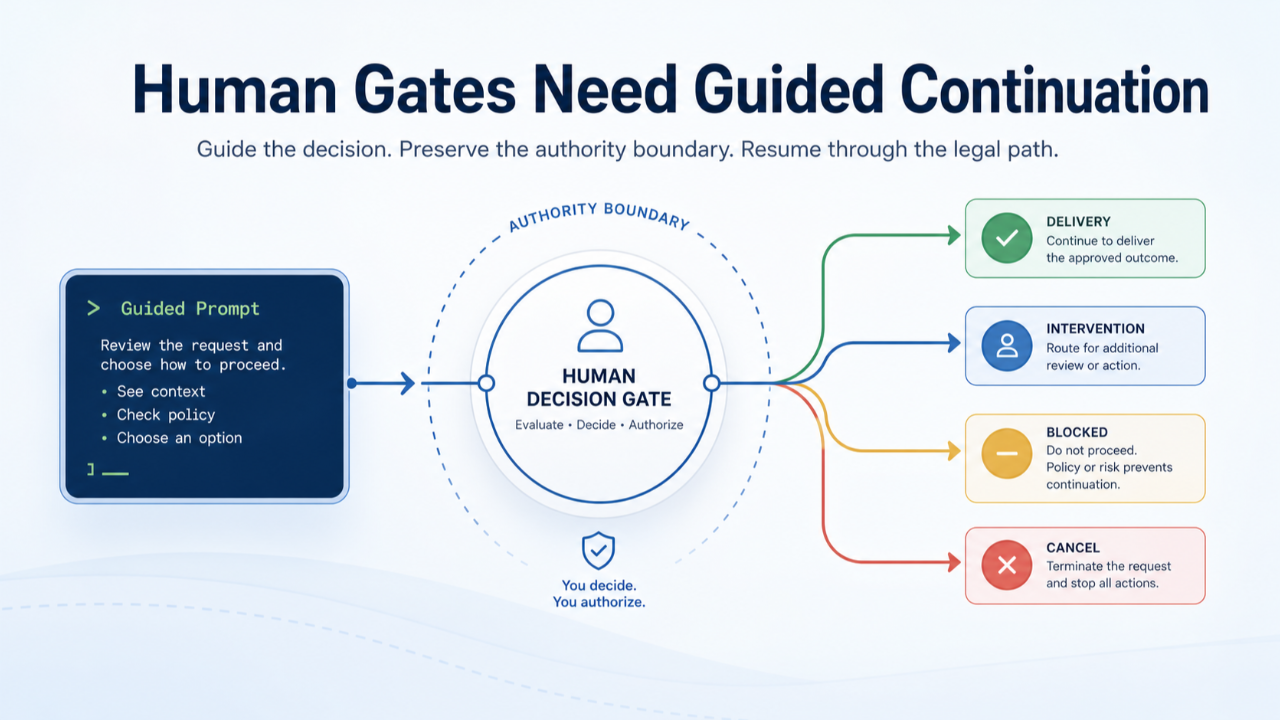
A human gate is not finished when the system prints instructions. It is finished when the operator can make the decision, the workflow records that decision through the authoritative surface, and the next legal path resumes without forcing the operator to become the lifecycle engine.
The Surface Problem
The visible problem looked like missing terminal guidance. A command led the operator up to a human decision point, then left them with manual follow-up commands. That was awkward, but the awkwardness was only the symptom.
The deeper problem was continuity across a governed boundary. Once a workflow pauses for human judgment, the next step is no longer ordinary prompt polish. The system must define who owns the decision write, which routes are legal after the decision, what cancellation means at that phase, and how the continuation result is surfaced.
The Real Problem
Human-gated workflows often have two different responsibilities sitting next to each other:
- the facade that helps the operator understand and enter a decision
- the authority surface that records lifecycle state and decides what may happen next
Those responsibilities should not collapse into one another. A helpful terminal flow can collect input, display context, and call existing APIs. It should not become a second lifecycle engine with its own route rules, state writes, or approval logic.
That distinction matters because the most dangerous version of a helpful prompt is one that looks convenient while quietly bypassing the boundary that made the workflow safe.
What Was Discovered
The hard parts were all phase-boundary questions.
- The input session that handled the first phase was already closed before the post-gate decision needed to be collected.
- Canceling before work is created is different from canceling after work exists and is paused at a human gate.
- The route displayed to the operator needed to come from declared workflow truth, not from inferred or duplicated logic.
- Delivery, intervention, blocked, and cancellation paths needed distinct handling.
- A no-write guarantee after cancellation needed stronger evidence than a mocked call path alone.
None of those questions is solved by adding more text to the terminal output.
What Changed
The useful pattern was thin facade orchestration.
The operator-facing command gained a guided decision phase. It displayed the gate context, collected the decision, delegated the disposition write to the canonical controller-owned surface, and resumed only through the established post-gate continuation path.
The facade stayed local and narrow. It did not redefine route validation, derive its own approval posture, invent rejected flags, or change the controller's ownership of lifecycle state.
That is the important line: guide the operator through the gate, but let the gate owner remain the gate owner.
Why It Matters
Human gates are supposed to add judgment without making the system informal. If the operator has to copy instructions into separate commands, the workflow becomes harder to complete and easier to complete inconsistently. If the facade tries to solve that by taking over lifecycle logic, the workflow becomes easier to use but less trustworthy.
Good guided continuation avoids both failures. It keeps the human in the loop, keeps the state transition authoritative, and keeps the post-decision path inside the workflow's existing contracts.
This is especially important in systems where a decision can approve delivery, require intervention, block progress, or preserve risk for later follow-up. Those are lifecycle meanings, not just menu options.
The Reusable Lesson
Human gates need guided continuation.
When a workflow pauses for human judgment, design the return path as part of the gate. Name the authority surface that records the decision. Name the route classes that may follow. Split cancellation semantics by phase. Prove that cancellation does not mutate state. Surface the continuation result clearly.
Do not make the operator bridge the lifecycle by hand, and do not let a convenience facade become a hidden controller.
Practical Checklist
Use this checklist when a guided flow continues after a review, approval, triage, or other human decision point.
| Check | Question | | --- | --- | | Authority | Which surface owns the decision write? | | Continuation | Which existing API resumes the workflow after the decision? | | Route classes | Which outcomes are delivery, intervention, blocked, or terminal? | | Cancellation | What does cancellation mean before creation versus after a paused item exists? | | Display source | Where does the route label and rationale come from? | | No-write proof | Is there fixture or artifact-level evidence that canceling leaves state unchanged? | | Facade boundary | Does the UI collect and delegate, rather than reimplementing lifecycle logic? |
Related Concepts
- Governed Workflows
- Human Gates and Approval
- State and Lifecycle Management
- Automation Reliability
- Developer Experience
- Safety-Preserving Operator UX
- Durable State Continuation
